Showing posts with label gaming industry. Show all posts

Sunday, November 16, 2014

5 Things That Are A Drag To The Gaming Industry

The gaming business is really thriving nowadays (some even saying that it is growing four times as fast as the U.S Economy), but if we take it from a research and development point of view, it has become stagnant in many ways and for a number of reasons. Today we are going to see 5 of those reasons why the video game industry is dragging its feet from a technological and innovative stand point. It is important to say that there are still good games and good business practices, but the bad ones you are going to see on this article are starting to become a real drag, so let's see.

Games with less features
1) Reckless technical advancements (this for that)
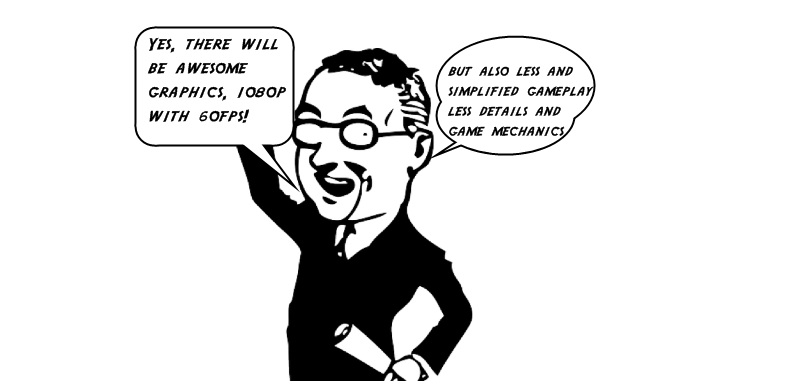
We all know that several game publishers are their own version of Mr.Crabs from Sponge bob, so they will do anything if it means them saving some money. Been things like this, it means that sometimes when a game gets the modern tech treatment it doesn't really improve, but changes priorities. For example one game that gets to have the most advanced graphics up to date, can become really short, have its content to be dumbed down or suffer from crippling bugs and glitches. All this because they so often focus on novelty trends and not on the aspects of what makes good game. It is a known fact that everything in a business runs within the so called "Iron Triangle", but if they can't bend the triangle, then they should at least make a stronger effort in order to maintain the quality of their products while working within its constraints.


Fanboy spotted

2) Fan boys frozen in carbonite.
Let's get something out of the way first. Designers and developers do make mistakes and most of the time need a healthy dose of user feedback, but the ones we are talking about are not feedback providers but fan boys that loved one iteration of a game and will stay with it for all eternity, frozen in time. This type of fellow is the one that whenever a new iteration of their favorite game comes out, it doesn't matter how much their creators tried to bring new things and innovate, for them it is just awful and "lacks the excellency of the original". The games and communities that feature this kind of obsessed gamer will not be mentioned, but if you are one of them you will know and will probably be looking at the screen like this. Be aware that this isn't the same as wishing some game genres to return or stop changing for the sake of change, because the one we are talking about is more about specific games and not the whole spectrum.


3) The "a game per year" business.
The moment when companies decided to spawn some of their big franchise games on a yearly basis was the moment when quality started to go down. This is when some bad practices started to become the norm, with things like recycling the same resources year after year, making the games to be shorter and over-simplified and/or refusing to make new engines in order to make use of the latest technologies. All of these wrong doings need to stop and for that to happen we need to stop giving money to them in exchange for a half-done job. Feeding these yearly franchises not only sets gaming innovation back, but also gives an incentive to gaming companies to stop caring about new projects and concepts and stay hidden in their comfort zone. Luckily for us, sale numbers have shown that the success of franchises that are stuck in this business model is starting to go down, so it seems like the gaming community is waking up on this one.


4) The Imitation Game
Some gaming studios and companies (including some of those who used to be fan favorites) have just become trend machines and this is very unproductive. If there is something that gaming history has told us is that game market competition is done in showdown style which is 1 vs 1 and not a whole bunch of companies imitating each other and doing the same thing. It is either a showdown or a bunch of games with moderate success with no clear winner, so they should stop trying to mimic what they see as "trendy" because most of the time they won't get to be the underdog who wins it all in the end like in the Rocky movies. This has caused a lot of franchises to lose their focus and their identity in the company's effort to cash in on the success of others, even turning some legendary companies from trusted developer to the laughing stock of the gaming industry. Stick to your guns people, do what you do best and stop trying to be something you are not.


5) Treating games like normal household appliances.
The gaming market is a very complex one that has a lot of variables that need special attention before coming with a product strategy and most companies are ignoring this. Many of these are treating video games as if they were just another household appliance, with the same metrics and marketing strategies and this is awfully wrong. Selling a frying pan will never be the same as selling a console or game, but they are been treated as if they were the same thing because the higher ups in many of these companies don't know anything about games or they lack the passion that is needed to work with them.

A gamer is a very elaborate type of consumer, but these non-gamer business guys in high places seem to think that we are the same person that you would sell a frying pan to. Because of this, they feel like innovation and high quality doesn't have to be the norm because we will buy anything they throw at us. To be fair, the blame doesn't fall entirely on the business people as the gaming community is indeed feeding this practice by buying their products and falling for every one of their tricks (incomplete games, DLC that shouldn't be DLC, pay to win schemes, half baked ideas, limited content, etc). It is kind of hard to understand why so many gamers think this is acceptable as the industry itself takes a hit every time that a "frying pan" type of game has success. Stop giving them incentives for cutting corners!


Wrapping it up
Shifting resources instead of increasing them, fan boys that force developers to do the same thing over and over again, releasing a game per year even if it feels like a copy paste, companies imitating each other and treating a game as if it were something as simple as a frying pan. These things are part of what is making the video game industry to become a slow and procrastinating entity that doesn't improve itself very often because it feels like it doesn't need to. Part of the blame is on gaming companies with their shady schemes and the other part falls on gamers who accept these bad practices. Do we as gamers have to sacrifice so much in order for the industry to survive? The answer is no, so gaming companies should step up to their game and gamers who accept these kinds of blunders need to wake up soon.  


Friday, August 15, 2014

The Different Types of Modern Fanboys

There was a time when been a "fanboy" was kind of fun. It was mostly a charade, a make believe as in reality everybody really enjoyed the "other team's" system and even when two (or three) fanboys did get into an argument, they mostly used facts up to the point when both of their arguments cancelled themselves and all was solved with a slice of pizza and a good gaming session. Unfortunately that was the past and now, we have a type of fanboyism that goes more around the toxic side and it has never been more worse than on this current generation. Reasons about why fanboyism turned from a fun mental exercise to a mindless game of empty arguments are plenty, but instead of mentioning reasons alone, we will see some of the types of fanboy that our modern times have spawned. Be aware, some of these may have existed in the past, but they were never so obvious as now.


Tunnel Vision Fanboy
Never argue with one of these, it will never end.
The "Tunnel Vision" Fanboy

This one is pretty stupid, but one of the most noticeable. Every time an exclusive game releases, we are bound to see their countless comments about how the game is "bad" and most of them clearly state that they are fans of the opposite platform. It doesn't even matter if the game goes out to become a big seller and win lots of awards, because based on the tunnel vision fanboy mindset it will always have a flaw that makes them talk trash about it. Sometimes they use nitpicking or other times try to act as if they are making an educated criticism or "sincere" statement, but we all know that it is crock from the moment we see it. We also know that there are people that can legitimately dislike a game for a number of real reasons, but if you read between the lines you can spot the real game critics and those who are throwing dirt on the game just because they are jealous.


Numerically Obsessed Fanboy
These ones make the protagonist of A Beautiful Mind look like the sanest guy on earth.
The Numerically Obsessed Fanboy

Take the word "numbers" here as everything that goes away from the games themselves and is used as a means of criticism. Things like financial numbers, resolution and frame rate values, number of copies sold and even how much time (in years) they spent making the game. The thing about this is that none of the previously mentioned things should matter. A game is all about how much fun we have with it and not how many big numbers it can crunch up. Fanboys should leave that stuff to industry analysts and focus on the things that really matters. Next time you see one of those, ask them to sell their consoles and buy a calculator and maybe some spreadsheet software instead.


Nostradamus Fanboy
If it were up to these people, we wouldn't have games anymore.
The Nostradamus Fanboy

Nostradamus was an apothecary and a seer from the 1500's who is mostly remembered for his apocalyptic predictions and prophecies. Now more than 500 years later this kind of fanboy is trying to continue his job, but from a videogame industry perspective. These are the ones that are constantly predicting doom for gaming companies based on trivial stuff that happens all the time and should be considered normal. Things like if a developer quits the company (OMG they are doomed), if the company closes one of their divisions (Yep, the company is going down), if the company loses some profit (Oh the humanity, bankruptcy is imminent!) and that sort of stuff. Most of the time it sounds as if the Nostradamus fanboy wants the company to fail, which is a pessimistic and screwed up way to think, especially when gaming is all about enjoying our games and not about creating doomsday prophecies or reflecting our own frustrations.


Quick Draw Fanboys
At the time you first read about an important gaming thing, these people already flooded the net.
The Quick Draw Fanboy

This kind of fanboy put Jesse James to shame, as they are some sort of neurotic individuals that like to jump the gun for anything, firing from the hip faster than in a glitched first person shooter. This is really noticeable when an important decision is made by a company and they just go nuts with nonsensical rants on forums and gaming pages, the creation of countless online petitions and stuff like that. This is the fanboy that goes into a temper tantrum that can only be surpassed by the ones thrown by toddlers when their parents refuse to buy them a toy while browsing through a department store. The real bad thing about these picturesque fellows is that they give a bad name to the entire gaming community, making the world believe that we are spoiled, self entitled big babies.


Michael Myers Fan Boy
These ones are the most embarrassing of all...
The Michael Myers Fanboy

For those of you that don't know, Michael Myers is the legendary villain of the slasher horror films called Halloween. He is dedicated to appear out of nowhere and stalk his victims (certain people) until he murders them in gruesome ways. Well, in the case of fanboys (and not necessarily console fanboys) these are the ones that get into the developers personal lives if they don't do what they want. This means stalking them on social networks, forums, gaming articles and everything related to that person. There have been several accounts of intense trolling and even death threats, up to the point that some developers have decided to quit the industry altogether. I am well aware that we should defend our interests as consumers and that is alright, but nothing ever gives us the right to go all personal on somebody because we can't accept the decision they made. Sometimes it isn't even about a game, but a comment or expression made by the person that manages to spark hatred among weak minded people. If this is now, I don't want to imagine what would happen if this behavior continues 20 years into the future. In what thing will it become? Public executions or developer vs developer roman coliseum styled death matches?


Gaming
Wrapping it up

There you go folks, 5 different types of modern fanboys that completely spoiled what been a fanboy was all about. Competition is always good, and brand loyalty is fine to an extent because everybody has their unique taste for gaming and may feel like home in one platform ecosystem more than in the others. The problem begins when this goes out of control and we lose sight of what the essence of gaming is. We must go back to the gaming attitudes of the past, when gaming was 100% about gaming and even if competition was fierce, nobody was losing their heads over trivialities.

Thursday, August 7, 2014

Nintendo on mobile? They should, but not as you may be thinking.

There has been a lot of comments going on about the Nintendo executives and investors throwing tantrums over if the company should enter the mobile market or not. First of all let me get this out of the way. No, Nintendo should never let their franchises to go mobile because that would be the equivalent of creating a black hole in the middle of the company and it will consume it from the inside bringing a slow and painful death. As they are right now Nintendo is one of the few companies that is still (almost) pristine in their ways and unsullied from any business dirt that comes from selling out... Well, maybe except for the Mercedes-Benz thing in Mario Kart 8, but that's just one separate incident as Nintendo runs most of their business by themselves most of the time and this uniqueness is what keeps them afloat, even on tough times.

Nintendo Mobile Mock Picture
A mock picture of how a Nintendo "master app" could look like.
The thing is that Nintendo could make cool stuff for mobile without selling out their souls to mobile platforms just for a couple of extra bucks. Something like this should be no problem for the big N because mobile app development doesn't require big development teams or high budgets as it would only take a handful of resources and a relatively small development cycle. The best thing about this is that with content creators are brilliant as the ones they have, a great deal of interesting mobile applications can be created and unleashed to the public, giving Nintendo products some extra value without losing themselves in the process.


Mario Kart 8 unofficial app
So a fan had to come and do what Nintendon't.
There are many possibilities about the mobile software they could make in order to support their consoles instead of attempting to replace them. For example, they could develop a support app for Mario Kart 8, sort of like the one someone actually made and was featured in Kotaku a couple days ago. They could also make official apps that give help in some games with mini guides and/or tips or even some sort of Nintendo World App (or something like that) that syncs with the Wii U and lets the user do all sorts of things like buying games, enter the Miiverse, add friends and that kind of stuff while on the go.


Star Fox App Mock Picture
Imagine yourself using a smart phone to help a friend in the upcoming Star Fox game for the Wii U.
Other way of seen this is to go a little farther than plain game support apps. Good imaginative things like apps that lets you help or attack somebody within a game (sort of like the Watchdogs app) could make up for really fun situations if they do it with the right games. They could also make an app that features augmented reality games for the Amiibos that can generate coins or some kind of reward to be used on games or even the e-shop itself. The possibilities are endless if they take mobile approach from the sidelines and come up with interesting and fun materials that add up to the overall experience.


Pay to Win is bad
If they are planning to go "pay to win", they better reconsider before they spoil the whole thing.
Even though all this mobile approach looks interesting, there are many ways it can backfire if they do the wrong things. For example if they get too greedy with their services it will not work. If they turn their mobile environment into a "pay to win" they also run the risk of botching the whole operation. They would have to be quite sensible about the users because this is something they had never tried before so it can go bad if they give the wrong impression. This is especially true on this day and age, where the simplest of complaints spreads like wildfire through the net and can have devastating consequences for a product (ask Microsoft).


Mario Bros Mario
Relax Mario, you don't have to jump to mobile devices to be good.
Wrapping it up

Nintendo can definitely go mobile, but they have to do it in a way that adds up to what they already have without having to replace anything. What they have been doing in these past months have been great and there should be no reason to make any drastic decisions, so all they need to do is to keep on building up until they reach a point where they can convince the non-believers and become an industry powerhouse once again. If that is what their higher ups are thinking then the mobile environment is a great untapped place for them to continue their efforts.

Tuesday, July 29, 2014

5 reasons why at this point, game remastered versions are alright.

After getting The Last of Us Remastered version today, I realized that even when many gamers bash the idea of an updated version of a game, for the first time in gaming history a second release for a game has become a good thing. Don't get me wrong, a half-baked rehash is still an awful thing to do, but when done right it turns from a "cheap cash in" to an opportunity for gamers and developers alike. Now in order to prove this point of view let's see the arguments that support it:


going too fast

1) The market has become too fast paced.

There used to be a time where a game that became a smash hit, lasted at least a year in the top along with a runner up that always followed close behind, but that thing doesn't happen that often anymore as gaming companies are always trying to keep on each other toes almost making it a race for the gaming community. Competition can get fierce and sometimes that becomes a flurry of games coming in a very tight time span. Take for example the next coming months from September to the holidays, there will be a lot of game releases on different platforms. This is not only a wallet slayer, but also a very time consuming thing as most of these games have online modes that require a lot of play time in order to fully enjoy them. When this happens, some of the games fall through the cracks and are not picked by all the potential buyers they should, (especially when it is a type of gamer that is always keeping up with novelty) so a remastered version of a game becomes a second chance to catch those that didn't bought the game when it was released for the first time and a chance for some gamers to get a little extra for their money as a reward for still having interest in the game even thought is is not new anymore.


Eat Sleep Play

2) Busier gamers get a break.

Gaming is for life, but let's face it. A lot of gamers right now are part of the working class, have a family and/or personal projects to attend to, so they don't have the same amount of time as they used to before getting these responsabilities. Sometimes when a wave of games come by, they can at most play 1 or 2 titles at a time so in this case a lot of new releases are just left hanging. Some of you may be thinking "So what? They just have to buy the games they missed at a later time", but it isn't that easy when we consider that new games keep coming all the time and these people gaming interests often get divided and conflicted (online oriented games vs single player experiences) when time is scarce. This is the reason why remastered games nowadays seem to be a very appealing option for gamers who have that kind of time limitation, especially when the remastered version includes past DLC and/or gameplay extras.


3) It breathes some life into a generation that had a slow start.

This time around, compared to previous console generations, we are seen a much slower pace in early game releases as too many third party companies are still clinging to the previous generation. This had kept the new consoles on some sort of gaming drought that has been hitting for almost a year, with most of the anticipated heavy hitters still on the 2015 list. On this case, remastered versions (done right) serve to inject some interest when they manage to give a clear contrast between the previous and current generations. That contrast is one of the things the begins knocking on people's heads like a drop of water on a rock, until it breaks it and get them to support the platform because they actually see a tangible difference. An example of the complete opposite is the Wii U launch fiasco, where people thought that the new machine was just another Wii and did not ran to the stores to get it as they did with the Wii itself.


Metro Redux

4) Keeps interest in the franchise.

We know that sequels on some famous franchises are almost a given, but these things take time. In order to keep the interest in the franchise going strong until that new game arrives, companies often use remastered versions and that is alright if they do it without the product been a cheap rehash of the same game and if the new version doesn't come a very long time after the original, like Zone of the Enders HD which was one that came too late to have any effect on a good franchise that was just lost in time due to several years of neglect. At this time, remastered versions of games that have been released in the last 2-3 years are good for their corresponding franchises as long as they make it count and don't try to low ball the gaming community or pretend that rehash from a 5+ year old game will sell the same as it did when it first came out. It is also worth pointing out that the success or failure of a game rehash SHOULD NOT be used as a barometer to measure the franchises worth (Konami, I'm looking at you).


Battle Programmer Shirase

5) Serves as exercise for game developers.

Right now, as many companies are still working with previous generation projects, it is a good thing for them to flex their developing muscle a little and warm up in the developing process of the new consoles. While they work with the new SDK (system development kit) tools that each console has to offer, they can get new ideas and test the implementation of various new things while working on a remastered version of their game. This makes it easier for them to explore their own concepts a bit and discover what new things can be implemented in the next game on the franchise. Of course, most of us don't see this happening as we don't have insider access to big game development studios, but in any developing environment (gaming and not) it is very common to make new ideas out of revisiting the old ones, spawning a lot of nice surprises and "aha" moments.


Last of Us Remastered

Wrapping it up

Based on how the videogame market is moving right now, remastered versions of games are not the dreaded money grubber scheme that they used to be. This is because we as a community have become smarter and by materializing our opinions with our wallets, we have forced companies into putting a little more effort into their game rehashes. It may be a temporary thing, but for now they seem to work and deserve a chance. Remember that if you support the franchise now, you are giving a clear message to publishers, saying that you will also support the new games that are to come in the future.

Saturday, July 5, 2014

Is the real evolution of gaming sleeping in the past?


At least 10 - 15 years ago, one could easily tell that every gamer was really hopeful about what was to come in the future as the end of a great gaming era was near. It is understandable that many people (especially younger gamers) would say that games back then had bad controls, primitive attempts at 3D graphics, awkward animations and similar faults, but on its core it was a very advanced phase in gaming history ruled by game design and story writing, meaning that for 50 dollars those video game aspects brought you some deep and compelling experiences that are still legendary up to this day. The problem is that somewhere along the way, everything that had been built up to that moment was just forgotten and replaced with half-baked practices. Don't get the wrong impression, gaming on this day and age is still great, but calling it an "evolution" is a little off, considering many of the things that were left behind and here are some of them.

game designer cartoon
Sad situation that happens even to the most famous of designers.

Freedom of design

The backbone of any video game is its design, it is something similar to making the layout of a stage on paper, drawing some platforms, some power ups, enemies and there you go, you have your own stage. Of course game design in the industry is not that simple, but it is as important as it has ever been. What happens with game design nowadays is that it should had stayed as it was, free. Writers and game designers make the hell of a team when they can work their ideas on a hassle-free environment, without somebody telling them that their ideas cannot be used because of some "market issue". For the writer it becomes very hard to come up with focused material if his/her ideas get blocked by the people upstairs. As for the designer itself, the time constraints, market trends and resource limitations have diminished what once was the biggest process in the making of a game and turned it in to an over-simplified version of itself.

 The making of Silent Hill 2

If you watch some "making of" documentaries about some older games, you can see how much creativity the developers poured into their projects when left loose with their creation.  These creative liberties are something that should had kept going in order for a real gaming evolution, as the creative minds would had met modern technology and would had been able to make wonders. There are some occasions in today's industry where games are designed as they should be, but you will have to look around a little in order to find them as it is not longer the rule, but the exception.

quick time events
Cutscenes vs game play. Which one you prefer?

Freedom to the player

Once upon a time, seen a cutscene or CGI video was something that was seen mostly as a reward. It was that small moment you had when you saw the story line advancing along with some eye candy, all in cinematic fashion. It was the graphic artist moment to shine and we all loved it. The problem right now is that sometimes if feels like some long cutscenes should had been game play instead. At other times a "quick time event" is all that it takes to ruin the game mood and leave you feeling like you should had played through that situation instead of pressing some button combination. 

Things like these take freedom away from the player, making the game shorter and throwing away some of the thrills that would otherwise be challenging and fun. It is as if they sometimes borrow things from the "on-rails" game play style to save some time or just try too hard to make it look like a Hollywood movie. As time passes there should be more game play and not less, that is one important thing in any game that claims to be part of the gaming evolution.

world map
Censorship should not be part of our modern world.

Freedom from cultural limitations and censorship

Cultural limitations have always existed, that cannot be denied, but for some time it seemed as if the line that divide games developed in different countries was blurring. Foreign games were trending in the west as well as American games were doing good in other places in the world regardless of topic or style. This train of cultural diversity in gaming was up and picking speed until censorship got tighter and it made it grind to a crawl. Now every game that is ready to be released suffers intense scrutiny that looks into the smallest of details in order to classify them as "not appropriate" for certain cultures. 

The acceptance of fiction for what it is has become something that the censors refuse to accept and this causes problems when a game tries to get a localization process. Along with censorship, another cultural problem is profiling. Marketing people have created this "rule" that basically profiles each region of the world and embed them to certain types of games and themes. This is also something that was at the verge of dying off, but made a comeback and (sadly for us) it is stronger than ever. It is hard to understand why haven't we parted ways with those things. Many other markets in the world have adapted to globalization, so why haven't the gaming industry done so?

angry gamer
The angry super "hardcore" gamer strikes again...

Freedom from ourselves

The consumer is a great part of what drives an industry and the gaming scene (that's us) is doing a poor job at it, even if it isn't entirely our fault. There was a time when a gamer's only concern was playing games and sharing experiences. At that time social networks weren't as popular, we relied a lot on magazines and word of mouth and all the tools we had as video game fans were simple, but at the same time a gamer was just a gamer, which helped to sustain an industry that was tailor made for us as gamers. Yeah, there were fan boy wars and things like that, but the community was not divided in niches, hardcore, casuals, "gamer wannabes", "real gamers", "dude bro gamers", "geeky gamers", "frikis" (in Spanish), "hipster gamers" and other labels that just seemed to turn it all into a game of factions, which gave game companies an incentive to divide the market as well and just give more attention to the "faction" that seems stronger instead of just the simple task of making games regardless of groups.

We as the consumers, got led by the marketing people into believing that we were all separated into groups, entirely working to their advantage instead of ours. Before that, they did not had a clear view of the market so that forced them to remain at a high level of quality at all times, but now they can just lay back and do whatever they want, following the easy money because they know what is trending and what is not. It is very unlikely for this to happen, but for a real gaming evolution to occur, we need to go back to been as single unit, gamers. This way we can throw a little fog of war in to the market and recover some of the advantage we had.

video game characters
If some of these characters have stood the test of time, other things must as well.

Wrapping it up

In conclusion, the real gaming evolution is all about making the gaming industry to be pro gamer again. It is the return of different things that we used to have a long time ago. It is the freedom of the past + the technology of today which equals a leap in gaming that we haven't seen for a long while. Graphics get better, systems become more powerful, but the core of the gaming industry is what needs to take some things from the past in order to really move forward, anything less than that is just a new version of the same thing.


Thursday, July 3, 2014

5 reasons why the AAA game obsession is harming the gaming scene


AAA video games are games with a high budget and big production values. They are nice, cause a lot of hype and give the gaming community something to talk about, but they are not the only games in existence. After reading the opinion that the big guy at Sony, Shuhei Yoshida had about the obsession with AAA games, you can pretty much see that game publishers and developers are getting kind of frustrated with the AAA game rush that is happening in the industry these days. Many gamers just want big games to happen overnight and while gaming companies are not entirely innocent about this, trying to rush the gaming industry is causing more harm than good and here are 5 reasons why.

Watchdogs
The game is good, but some of its potential was hidden in order to meet the deadlines.

1) The sacrifice of quality over speed.

This one is all about the various game developing processes that are affected by rushed developing cycles. First of all, the creative process gets shortened to an extent that many good ideas that gamers could had enjoyed are lost in the process because there is not enough time to include them. Then the game design process is forced to become "too safe" for its own good, so the main base of the game you will pay 40-60+ dollars for is stripped off any "unnecessary" (unnecessary meaning cool stuff) design practices which almost leave the game with a basic canvas that ends up lacking. Finally the technical process becomes a race to the finish line, increasing the possibility of the game having bugs or technical issues that people will most likely complain about later. When all this happens, at least 25% of what could had made a game great is lost.

call of duty
Did you knew that up until know they have been using the same engine over and over again?

2) The dreaded "one year" development cycles.

Even when many people seem to hate when a good franchise gets the "one year - one game" treatment, we have to accept that this is a by-product of wanting big games too fast. Publishers are not just there because of the games, they are mostly because of the money and if their marketing specialists see that demand has risen to a point where they can no longer support it by normal means, they will recommend to speed things up, thus the "one year" development cycle. This causes a lot of things like recycling of resources, decrease in innovation and it basically grind creativeness to a halt up to a point where the only thing that changes are the characters and setting, sort of like one of those cheap novels you find in some department stores for a few bucks.

Valkyria Chronicles
Are we ever gonna get a sequel of this on America?

3) AAA Franchises with a slow development process die off.

When was the last time we saw a revolutionary cutting edge game, with more than 25 hours of game play, featuring new things and nice visuals? We have seen a few exceptions to the rule, but on the broader aspect of things, any franchise that needs to have a slow development development process is marked for death or at least ridiculously delayed. Take for instance many of the games that have vanished. Most of them have some things in common like dynamic game design, detailed game worlds and storylines that go a little deeper than your average "good guy vs bad guy" cliche.

All these things take time, which means that they can't rush them and much less "dissect" them (see point #1) because then the fans will not support it. So what they do is that they ignore those games, but use their names as promotion because they know that fans will love to hear that their favorite franchise is still alive. This is the reason why we haven't seen games like Half Life 3, Beyond Good and Evil or The Last Guardian for a long while. Their development process is slow, so companies never focus on them because they feel like they need to keep an always hungry AAA game crowd happy at all times. Sort of like wanting to offer a professional chef-style dish, but having to settle out with cheap plain burgers because people are asking for food and they want it fast.

desert
This is how the market looks like sometimes and it is our own fault.

4) It causes gaming "droughts".

One of the things that the AAA game obsession has done is kill smaller studios because they are not been supported anymore. Back in the past, smaller studios on the mainstream market (non-indie) were the ones that gave us something to play while the big budget games were developed. It was like going to the game store and seen all these obscure games that had weird release dates and were not advertised that much, later on discovering that they were great under-appreciated gaming experiences. This does not happen anymore because most of those studios have either closed, been absorbed by a bigger company or went "indie" only. For some reason, many gamers decide to wait until the big games are released and pass on anything else.

This created a sort of black hole in the market where all these small studios got sucked in and now we suffer gaming droughts because of it. Let's face it, there are too few small gaming studios in the big market and the ones that are still there are not releasing games like they used to because they have no incentive to make great productions anymore because too many people are just sitting on their consoles waiting for the next new AAA game and not giving anything else a chance.

Castlevania SOTN Alucard
With Igarashi out of Konami we will not see something like this anymore.
5) It saps motivation out of the game companies.

This is a chain reaction that happens when the publishers lay the smack down on their developing teams based on the market (now frivolous) demands. This takes a toll in not only the programmers, but the game designers, writers, musicians and all of the creative team as they struggle to meet the deadlines while leaving precious ideas dead on the table because they don't have enough time/resources to do it. This is in the case that the project becomes a reality and doesn't get canned like it has happened to many games out there. In the end, the motivation to create becomes scarce and many of the most famous developers just give up and become figure heads or just leave the company (which is good for them, but means that the franchise they worked on for so long is either dead or will never be the same).

Tales of the Abyss Anime
The best thing to do is to relax, play and have fun.

Wrapping it up

The gaming industry is going too fast for its own good and this must stop if we really want gaming to be become better instead of a re-hash fest. We must re-learn that good games take time and give a chance to all those "not so famous" games out there, be them in the indie scene or in the mainstream market. We need to stop waiting exclusively for the big games and just play and have fun with what we have. There used to be a time when gaming was based entirely on playing and not on trends or the next big thing so it would be healthy for the gaming scene if we return to that line of thinking, especially if we want our favorite franchises to survive and game developers to keep their creative freedom. This can be achieved and it is all up to you.

Tuesday, June 24, 2014

The problems with Crytek

Crytek Logo

Crytek has been one of those gaming companies that has always managed to impress the gaming community with their games, so it is a little perplexing to read all of these rumors about them having a really bad time as a company as has been reported by various gaming sites. Things like the apparent cancellation of the Ryse 2 and them not paying their employees in time, mark a very difficult time for the creators of Crysis. Today we are going to see some things that may have contributed to their current state of affairs in a way that we can theorize about what went wrong, so let's get started.

The first Crysis game. Can it run Crysis?
Back at the day, this was the poster child of high end gaming.

1) Going away from what fans loved about their games

From the first time they jumped into the gaming scene and made the first Far Cry, Crytek became the new cool thing in video games with their open world style and action packed games. For a time there, we went from playing linear first person shooters to actually exploring a game world where we could do almost anything to survive. Take Crysis for example, in that game you were first thrown in a jungle and you had to make your own tactics without any cues or tips. If you saw some enemies on a cabin you had to make your own way to dispose of them or else you were dead meat. That kind of thing resonated with gamers and made Crytek very popular in a very short time.

After that they somehow changed. As their games made their entrance into home consoles, they felt that they could no longer do their own thing began inspiring themselves on other successful shooters at the time. This lead them to turn away from their unique style and more into the "broader audience". Their games even though they were still good, began to feel like ordinary shooter games. Some say that there was a technological barrier preventing them from making the real next Crysis on home consoles, but it is more likely that they thought that their original style wasn't going to do well with a generation that was oriented to quick game play with an emphasis on online multiplayer. So in the same way that it has happened to other companies, Crytek games tried to roll with the crowd, but failed to get that smashing success that they were waiting for as fans were turned off by their new game play styles and the broader audience was too busy playing other well established shooters. It's a story that the gaming community has seen countless times.

Crytek Homefront
A great concept that fell short because of bad timing.
2) Bad timing

Crytek games have always been high quality experiences, but most of the time they had been drowned by the current trend, especially in the shooter craze that we experienced in the previous generation of consoles. Games like Crysis 2 were often compared to Gears of War, while other games like Far Cry and even Homefront were sandwiched between games like the Call of Duty: Modern Warfare series and later by EA's Battlefield 3. This is a bad thing that always happens in the gaming industry and it seems that it will never change. There is always a point in a video game generation in which some games get to the top and most of the time stay there until the very end when the trend pool seems to reset and the industry balances itself prior to the beggining of a new cycle. Crytek tried to take the crown out of the hands of the industry leaders at the time, but could not do it.

This was redemption, a Crytek new I.P that was cancelled.

3) Lack of new I.P

Every time we hear the name Crytek, we think about Crysis and previous Far Cry games and while both are excellent series, there is always this impression that they have a lot more to give. It is likely that many gamers think that the people that gave us such a brilliant game as the first Crysis would be able to give us something new while following their own style. In an open world gaming environment, anything can happen. They can write a clever story, develop any gaming mechanics that fit in to that game world and create a new game that can put them back into the competition. Some would say that Ryse: Son of Rome was a step in that direction, but although the game was good enough, it was a previous Kinect game project that got beefed up and changed for the Xbox One launch, so it doesn't count.

Another worrying thing is the line of cancelled games that the company has, it seems that new ideas were coming, but got lost in development hell. For some reference see this list made by IGN that shows all of Crytek's games and notice how many of them are cancelled. The sad thing about this is that almost every one of those cancelled games seem to be new ideas.

CryEngine 3 logo
After this one, Crytek won't be naming their engines with numbers.


Wrapping it up

Right now, as far as the rumors go about the game studio current situation, it is very unlikely that the things explained in this blog entry can be fixed any time soon, but with time they can be. One thing they can do is to use the current console generation side by side with the PC gaming scene and make a comeback as the Crytek we all knew about. It would be unrealistic to expect a super powered Crysis game made in the same way as the first one, because this would cause problems between the console and PC versions (ask Ubisoft about that kind of thing), but they can bring that feeling back without having to go all out on technical aspects. They can also make new games that could serve them well if they point to the right trends and market. Their CryEngine is powerful so they can use it to bounce and make a comeback, but for now, let's just wait and see.

Monday, June 23, 2014

How the virtual reality concept that gamers crave is at risk again

Binary vortex
It has been one of the most acclaimed sci-fi topics ever, featuring in various works of fiction and sparking our imaginations from the very first moment we heard the term virtual reality. In a bigger or smaller scale, we all have an escapist inside and VR is the holy grail that our inner escapist yearns for. Be it through something like the Star Trek holodeck, VR headsets or even one of those big VR spheres that are sometimes shown in sci-fi movies, many of us want to experience a reality similar to our own, but without the risks. This craving is even bigger to us gamers, as video games are in fact small windows into other realities and year after year as technology progresses we have been getting closer to experiencing that almost perfect VR experience we have always wanted. Back in the 90's there were several attempts to bring VR closer to our living rooms, but failed because the technology was not advanced enough. Now our technology is powerful enough to make it happen, but another big obstacle stands in the way of progress.

The Virtual Reality as dreamed by gamers

The Lawnmower man villain
If you remember this movie, then you were a 90's kid, a time where everything in movies was surreal.

A part of the gaming community has always seen virtual reality as the ultimate form for a video game. The notion of been in a game world where there is no television/monitor and almost no queues to remind you that you are living in planet earth and just playing a game is quite appealing to many. Back in the 90's VR was all about cheap toys that attempted to rip us off, but nowadays we have stuff like the Oculus Rift, Project Morpheus and a variety of other virtual reality devices that are still in development. Recent tests with this new wave of VR equipment has given good results and for a time it all looked perfect, until real dedicated user tests were made.

The Problem 
Anime character with nausea
An anime representation of the problem.

The problem that virtual reality headsets are having this time around is not about technology or weak equipment, but about the human body itself. Many developers already fear that VR headsets are too much for the human body to handle and may cause nausea, vertigo and vomiting to the person using them. This is because even if the virtual world is in fact fake, when the human brain accepts all the sensory input as if it were the real thing, there is a chance that hidden flaws in the person sense of orientation will show, resulting in the player feeling sick after at least half an hour of game play.

Vertigo inducing angle
Vertigo doesn't necessarily has to come from high places.


Just picture it this way, vertigo is one kind of specific dizziness caused by feeling as if everything is spinning even when it is not. So this means that games running as virtual reality environments that go on a first person view and feature certain angles and jerking movements are quite capable of causing this kind of effect on people.

This kind of thing has apparently happened a lot with various developers while testing VR headsets with some of their games. For example the people at Respawn have tested VR headsets with Titanfall and concluded that players were experiencing problems because of the fast and vertical style of this first person shooter. Another team that got aware of this is the team working with Project Morpheus at Sony and even EA found out that VR headsets were making players sick in tests ran with their most recent build of Mirror's Edge 2. While those teams were having those kinds of problems, the team that is developing Project Cars had almost no problems and they look forward to making their game compatible with Sony's headset.

What if this problem is not solved in time?

virtual reality cartoon
VR guy in wireframe VR world with t-rex... hey it could happen!

It is not all doom and gloom, as all the development teams invested on VR head compatibility with video games are currently working on a way to fix the sickness problem and be able to go ahead and give us a nearest to reality and safe VR experience with their games. There is still a lot of hope, but if this problem is not fixed in time, VR headsets will not be able to give gamers the VR experience they wanted, and will be limited to games where there is not so much movement going on (like driving games) or more passive VR experiences that will be interesting enough, but will lack the real thrill that the virtual reality dream stands for. This does not mean that for virtual reality to be good, it needs to be in the form of  fast paced first person shooters, but if they can't emulate real life perception, sensory input and movements because of the sickness problem, all that will be achieved will be nothing more than video games seen through a headset.


technology art
Maybe the human mind is even more complicated than we think.
Wrapping it up

Virtual reality has risen, but once again it runs the risk of passing as a fad, at least in the video game industry if the sickness problem is not taken care of. If you are a gamer and a virtual reality enthusiast your best bet is to put your hopes in the works of the various brilliant teams working with this kind of technology, hoping that they can overcome the challenges ahead and that VR and gaming can finally be a feasible concept. Even on the other side of things, if you are not that much into virtual reality, just know that the advances with VR technology could really help gaming as a whole, so everybody wins.

Saturday, June 7, 2014

An alternate universe: Sony and Nintendo making the SNES-CD.

It is quite certain that most of you are well aware of what the gaming world looks like now. We have 3 major home consoles coming from Microsoft, Sony and Nintendo, two handhelds coming from Sony and Nintendo and gaming PCs that have always been there. You know who are the top players and who are the underdogs, but do you know how different it could had been if certain decisions were made at specific points in time? Today we are going to look into one personal theory I have about a particular "alternate universe" that would had happened if:

If this had happened, maybe we would had played Donkey Kong Country as a 2.5D game.


Nintendo and Sony had kept their partnership (1991).

Note: This is just a personal theory so your own opinions may greatly differ from the ones expressed on this article, so bear with me and if you have any different ideas, leave them on the comment section as it is always interesting to talk about these things.


The classic champion of the 90's


The origin of the first Sony home console is a story of separation. It is said that at first, what we came to know as the PlayStation (or PS ONE) was just going to be a disc drive peripheral for the Super Nintendo, that would had enabled the console to jump to the next generation without having to actually make a new machine. For a while it seemed that Nintendo was going to take that path, until they decided otherwise and then Sony decided to go solo which led to the birth of the PlayStation which meant the end of Nintendo's dominance over the industry and the beginning of Sega's downfall.

What could had happened differently if the Nintendo/Sony alliance had been kept?


Imagine if this war had never ended...


(1991 - 1999)

  •  The Nintendo/Sony alliance would had crushed the Genesis and later on the Sega CD even before it had a chance, because they would simply have the better games vs the unimpressive library of interactive movies that the Sega CD is known for. 
  •  Sega would had realized that it wouldn't be wise to make the 32X because they would had been cut to size again, so they would had jumped straight to the Saturn, later on overtaking the SNES-CD because of having superior technology and more advanced looking games. Another important thing would be that because of the success of the Saturn, Sega of America and Sega of Japan would had most likely kept the peace instead of going against each other and because of that, promising games like Sonic Xtreme would had been released without any problems. 
  •  Sega had become a fan favorite, but Nintendo was not stupid and had been in development of the Nintendo 64 all along so now the Sega Saturn and a disc based Nintendo 64 would lead another classic console showdown. With superb first and third party games evenly separated between the two platforms, this would had sparked a fan boy war that would had been worse than anything we had even seen.
  •  Sony, seen that both the Saturn and the CD based Nintendo 64 were too far ahead for them to enter the competition, would had then began working on the PlayStation concept in complete secrecy, preparing for a later release (1998-1999), but it would had kept the CD format instead of jumping into DVD territory because the technology would had been too expensive to put on a console at the time. Also the machine itself would had been as powerful as a Dreamcast so this would mark a time of success for Sony as everybody would had been very impressed with their machine. Making the console market stand at a virtual tie before Nintendo and Sega unveiled their new consoles.


Because with disc media, size matters!


(2002 - 2006)


  • After a long battle without a clear winner, Nintendo and Sega would had moved to release their new consoles which would had toppled the PlayStation in terms of power. Sega would had jumped to the DVD format while Nintendo would still had gone to the mini-disc because of fears of piracy and both consoles would had been released approximately in the 2002 to 2003 time span. 
  • The battle would had been fierce and Microsoft would had come up with the original Xbox a lot earlier than they really did (2002), but would had been kept at a very distant third place followed only by the PlayStation who's original lifespan was at its end. 
  • At the end of that generation, the battle would had been won by Sega (mostly because of the difference in disc format) with Nintendo learning its lesson and Microsoft gearing up for a second try while Sony who played the waiting game on that generation, would be ready to release the PlayStation 2 in the year 2007. 


War...War never changes...

(2007 to the present day)

From here on, there would had been a 4 way death match with all major companies having a console at once. This one would have Nintendo with a slight lead, with Sega and Sony almost tied at the second position while Microsoft stands at a 4th place and would be already showing signs of dropping out of the console race and sticking to PC gaming instead (quite possibly having a Steam like store or even making a partnership with Valve). At our present day, we would probably be seen the great presentation of the new Nintendo, Sega and Sony machines, with so much hype that we would be counting the days until the event.

To wrap things up:


Alternate universes... Sparking our imaginations like always.


Effects of this alternate universe on our present time:

  • The tight competition would had left so little space for error, that companies would not had the chance to experiment into new audiences meaning that the casual gaming movement that the Wii started would not had happened at the gigantic scale it did on real life.
  • Console gaming technology would not be as advanced as it is now so the PC gaming platform would be far ahead of consoles in terms of power, which would make gaming PCs to be even more popular than they already are.
  • The indie gaming scene would be something that would be almost exclusive to the PC platform, with Microsoft and Valve at front.
  • Formats like Blu-ray and HD-DVD would be something relatively new for consoles at the present time, but with the arrival of the digital game age, the use of physical media would not be as favored as it is now.
  • Game exclusives would still be something that happened very often, while the multi-platform trend would be held back by the intense battle that the companies would be having to bring the best games into their platform.
  • We would see a bigger number of localized games reaching our shores because the Japanese style of making games would had never lost its focus so American and Japanese types of games would still be separate things instead of one trying to imitate the other.
  • The motion-controlled gaming craze would had never happened and we would be more inclined towards virtual reality and VR headsets a lot more early than we currently are.
  • All major companies would had been forced to create at least twice the quantity of first party games while keeping their classic heavy hitters from becoming dormant. This because the market would had not become complacent, so companies would had felt pressured to outdo themselves at every chance they got.
  • Much of the franchises we in reality see as dead or missing in action, would be pretty much alive and kicking.
Now imagine for a moment that this little alternate universe is real. Do you think that gaming would be better or worse? I leave that judgement call on your hands.