Showing posts with label gaming companies. Show all posts

Sunday, January 25, 2015

The P Diagram (or how to kill a franchise)

There is a relatively common trend that has been getting stronger and sweeping gaming as we know it. It is often an unexplained phenomenon, but at least we can quantify it so I came with a visual way of seen this aberration and that is the P diagram. Today we are going to see the how this kind of thing is happening based on this simple image:

This is the P diagram and it is how many game companies are treating their games. This is the process in which many great franchises are just buried as if they never had any success. The P diagram is not a complex thing to visualize as a whole, but let's start from the very beginning which is the sweetest spot on this cycle.


BIRTH


Birth is the step in the cycle that all game fans love. It is the moment a game releases and becomes a staple of your life as a gamer. At times we don't expect the game to be so good and we just take a leap of faith that is greatly rewarded once we start playing. This step is the part where the community, gaming media and others start praising the game for it's great content and presentation up to a point that it creates believers out of skeptic and although it may not be a perfect piece of software, it was good enough to spawn it's own strong fan base. After this initial success, the company may release a sequel or spin off just to keep the ball rolling, so this is where it all becomes hectic (in a good way) just before it all calms down.


HYPE


Gaming companies should avoid saturating their franchises or else their quality will be affected (like those silly 1 game per year releases), so after the initial positive reaction goes cold, there is a set amount of time where there are no news about the franchise, but the fan base remains strong. It is the same as a blacksmith letting a red hot blade he just took out of the furnace to cool off in order for it to get solid. It is at this point of the cycle where brand loyalty (same as the blacksmith's sword) will solidify and become even stronger, causing a lot of hype and expectations. As this happens, fan fiction, speculations and rumors begin to flourish as well as a lot of fan service coming from the fans themselves. Now after some time passes, fans start running out fuel and will ask for new material and this doesn't mean more fan based stuff, but the real thing.

In a perfect world, companies would use this hype to boost public interest in their next production to unprecedented levels before releasing a new entry in the franchise that would shower them with money. Sadly the reality is that most of the time the spike in hype is just used to keep gamers interested in the company and not the game itself, so in a scum bag type of way they are using the franchise as a cheerleader rather than an official company product.


MURDER


At this point hype is still very high, so the gaming media prepares itself to shoot some direct questions and sadly, company employees and higher ups get prepared to block or dodge them. This is the part where we find out that they have no intention of actually releasing the game or that they are just dragging their feet hoping that we just forget about it. This not only applies to making a new entries on a franchise, but it also to other forms of publishing like localizing a game from one region to another (because if a game stays out of your region it is basically as if the game didn't exist and it becomes nothing more than an annoying tease).

It is the murder part of the cycle where company officials come with the most ambiguous or plain dumb excuses. Sometimes they say things like "it isn't in our plans to release it" or they just go with "yeah, we are developing the game, but it is not a priority" or even with "we are waiting until we make another game that surpasses it". These are just some of the "great comebacks" that corporate fellow come up with, but if we throw some logic to those replies we would say that publishers are:

A) Oblivious to the fan base they have created.
B) Making the game one line of code per day.
C) Shoving unwanted stuff to us just because (like saying "Oh you want pizza? Well, here you have some plain crackers. Maybe if you eat enough crackers, we will get you a slice")
D) All of the above

Also at this point companies start making illogical "surveys" by releasing an HD version of an old game and using that as a barometer to see "if people have enough interest". Going back to the pizza/crackers example, this is like they are giving us a left over pizza slice from two months ago and expecting us to savor it as if it were freshly out of the oven, just to see if we still like pizza or not.


DENIAL


This is where the fans lose hope and brand/franchise loyalty takes a hit. Publishers can say whatever they want, but at this point nobody believes them other than those with the biggest sense of blind faith. At this final part of the cycle we finally figure out that we've been fooled. They talked a lot about it, showed us a glimpse of what probably was just some work that was left undone or some previously canned concept just to stir the hive and make us look towards them in order for them to show us their "new" stuff. At this point, fans of the game leave the bandwagon like fans of a losing baseball team in the bottom of the 9th inning and it is at this very moment that it becomes very typical to hear somebody come with the dumbest of remarks. A remark that would be like:

"Hey, I told you guys that people didn't wanted that franchise anymore"

So there we go, we get out empty handed while the publisher loops directly to the hype point again and the fan base gets thinner and thinner until there is really no more interest for what would had probably been one of those franchises that stood the test of time.

So now that all the explaining is done, let's end this by seen a list of 20 games that are currently stuck in the P loop, just to prove that this is indeed real and not something that was just made up:

  • Half-Life 3 (a lot of teasing, but nothing so far, it has become a joke).
  • The Last Guardian (not a priority, says Sony).
  • New Mother / Earthbound (Nintendo seems to be scared of their own game).
  • Final Fantasy 7 remake (remember the massive trolling at the Sony conference?).
  • Legend of the Dragoon 2 (Yoshida said that project started in 2001, but was left unfinished).
  • Mega Man Legends 3 (project probably canned just to spite Inafune for leaving).
  • Mega Man Universe (suffered the same fate as Legends 3).
  • Zone of the Enders 3 (project canned because the HD collection did not sold well).
  • Crash Bandicoot (Sony teases with the mascot, but doesn't get it back).
  • F-Zero (Mr. Miyamoto says that he doesn't "know" how to make another one that works).
  • Wild Arms (studio says they would like to make a new one, but nothing so far).
  • Suikoden (Suikoden 2 sells really well on PSN, yet Konami says nothing).
  • Metroid (it seems that Nintendo will use the old prime series as a barometer).
  • Contra (MercurySteam said would make it then fell silent).
  • Super Mario RPG 2 (in 2006 Square Enix said that if Nintendo wanted, it could happen).
  • Any Mistwalker JRPG (they say they have interest, but nothing else happens).
  • Phantasy Star Online 2 on the west (Sega says that it is not on their future plans).
  • Shenmue 3 (Sony and Microsoft flirt with the idea, but neither of them confirm anything).
  • Legacy of Kain / Soul Reaver (talked about it, then came with Nosgoth instead).
  • New Fatal Frame (not even the developers know why Nintendo has kept it in Japan).


Sunday, November 16, 2014

5 Things That Are A Drag To The Gaming Industry

The gaming business is really thriving nowadays (some even saying that it is growing four times as fast as the U.S Economy), but if we take it from a research and development point of view, it has become stagnant in many ways and for a number of reasons. Today we are going to see 5 of those reasons why the video game industry is dragging its feet from a technological and innovative stand point. It is important to say that there are still good games and good business practices, but the bad ones you are going to see on this article are starting to become a real drag, so let's see.

Games with less features
1) Reckless technical advancements (this for that)
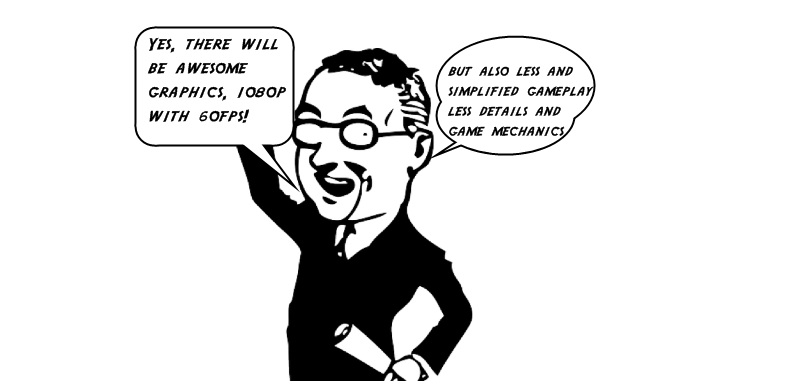
We all know that several game publishers are their own version of Mr.Crabs from Sponge bob, so they will do anything if it means them saving some money. Been things like this, it means that sometimes when a game gets the modern tech treatment it doesn't really improve, but changes priorities. For example one game that gets to have the most advanced graphics up to date, can become really short, have its content to be dumbed down or suffer from crippling bugs and glitches. All this because they so often focus on novelty trends and not on the aspects of what makes good game. It is a known fact that everything in a business runs within the so called "Iron Triangle", but if they can't bend the triangle, then they should at least make a stronger effort in order to maintain the quality of their products while working within its constraints.


Fanboy spotted

2) Fan boys frozen in carbonite.
Let's get something out of the way first. Designers and developers do make mistakes and most of the time need a healthy dose of user feedback, but the ones we are talking about are not feedback providers but fan boys that loved one iteration of a game and will stay with it for all eternity, frozen in time. This type of fellow is the one that whenever a new iteration of their favorite game comes out, it doesn't matter how much their creators tried to bring new things and innovate, for them it is just awful and "lacks the excellency of the original". The games and communities that feature this kind of obsessed gamer will not be mentioned, but if you are one of them you will know and will probably be looking at the screen like this. Be aware that this isn't the same as wishing some game genres to return or stop changing for the sake of change, because the one we are talking about is more about specific games and not the whole spectrum.


3) The "a game per year" business.
The moment when companies decided to spawn some of their big franchise games on a yearly basis was the moment when quality started to go down. This is when some bad practices started to become the norm, with things like recycling the same resources year after year, making the games to be shorter and over-simplified and/or refusing to make new engines in order to make use of the latest technologies. All of these wrong doings need to stop and for that to happen we need to stop giving money to them in exchange for a half-done job. Feeding these yearly franchises not only sets gaming innovation back, but also gives an incentive to gaming companies to stop caring about new projects and concepts and stay hidden in their comfort zone. Luckily for us, sale numbers have shown that the success of franchises that are stuck in this business model is starting to go down, so it seems like the gaming community is waking up on this one.


4) The Imitation Game
Some gaming studios and companies (including some of those who used to be fan favorites) have just become trend machines and this is very unproductive. If there is something that gaming history has told us is that game market competition is done in showdown style which is 1 vs 1 and not a whole bunch of companies imitating each other and doing the same thing. It is either a showdown or a bunch of games with moderate success with no clear winner, so they should stop trying to mimic what they see as "trendy" because most of the time they won't get to be the underdog who wins it all in the end like in the Rocky movies. This has caused a lot of franchises to lose their focus and their identity in the company's effort to cash in on the success of others, even turning some legendary companies from trusted developer to the laughing stock of the gaming industry. Stick to your guns people, do what you do best and stop trying to be something you are not.


5) Treating games like normal household appliances.
The gaming market is a very complex one that has a lot of variables that need special attention before coming with a product strategy and most companies are ignoring this. Many of these are treating video games as if they were just another household appliance, with the same metrics and marketing strategies and this is awfully wrong. Selling a frying pan will never be the same as selling a console or game, but they are been treated as if they were the same thing because the higher ups in many of these companies don't know anything about games or they lack the passion that is needed to work with them.

A gamer is a very elaborate type of consumer, but these non-gamer business guys in high places seem to think that we are the same person that you would sell a frying pan to. Because of this, they feel like innovation and high quality doesn't have to be the norm because we will buy anything they throw at us. To be fair, the blame doesn't fall entirely on the business people as the gaming community is indeed feeding this practice by buying their products and falling for every one of their tricks (incomplete games, DLC that shouldn't be DLC, pay to win schemes, half baked ideas, limited content, etc). It is kind of hard to understand why so many gamers think this is acceptable as the industry itself takes a hit every time that a "frying pan" type of game has success. Stop giving them incentives for cutting corners!


Wrapping it up
Shifting resources instead of increasing them, fan boys that force developers to do the same thing over and over again, releasing a game per year even if it feels like a copy paste, companies imitating each other and treating a game as if it were something as simple as a frying pan. These things are part of what is making the video game industry to become a slow and procrastinating entity that doesn't improve itself very often because it feels like it doesn't need to. Part of the blame is on gaming companies with their shady schemes and the other part falls on gamers who accept these bad practices. Do we as gamers have to sacrifice so much in order for the industry to survive? The answer is no, so gaming companies should step up to their game and gamers who accept these kinds of blunders need to wake up soon.